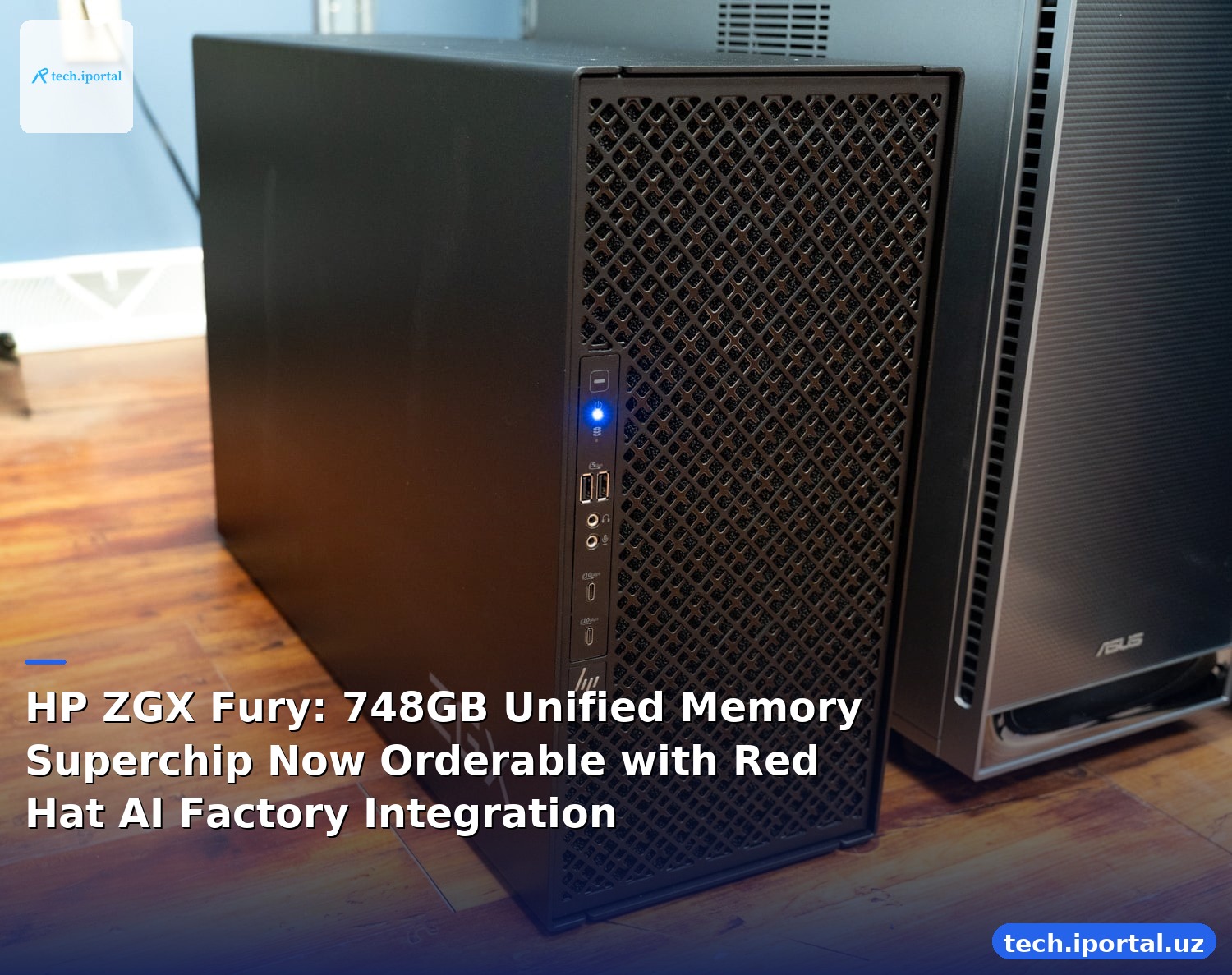
HP has officially opened sales for its new ZGX Fury AI workstation, a high‑performance platform built around the GB300 Grace Blackwell Ultra superchip. The system boasts 748 GB of unified memory and up to 20 petaFLOPS of FP4 compute, positioning it as a shared inference box for departments, factories, or branch offices that need local AI processing without a traditional data center.
Overview
The ZGX Fury follows the design philosophy of NVIDIA’s DGX Station but is tailored for edge deployment. HP’s announcement pairs the hardware release with a collaboration with Red Hat and NVIDIA to run Red Hat AI Factory on the platform. This integration promises a streamlined, enterprise‑grade AI workflow that can be deployed locally while maintaining the security and scalability expected from cloud‑centric solutions.
Hardware Architecture
The core of the ZGX Fury is a single GB300 superchip, which combines a Blackwell Ultra GPU with a 72‑core Grace CPU. The GPU delivers 252 GB of HBM3e memory at 7.1 TB/s, while the CPU is coupled with 496 GB of LPDDR5X memory via NVLink‑C2C. The two memory pools are coherent, creating a 748 GB unified address space that allows the GPU to access CPU memory directly. This architecture is essential for running trillion‑parameter inference and fine‑tuning models in the 100 billion‑parameter class on a single box.
- GPU: Blackwell Ultra, 252 GB HBM3e, 7.1 TB/s bandwidth
- CPU: 72‑core Grace, 496 GB LPDDR5X, NVLink‑C2C connectivity
- Unified memory: 748 GB coherent space
- Compute: up to 20 petaFLOPS FP4
- Cooling: liquid loop rated 1,400 W, maintains GPU at 71 °C under full load
Memory and Compute
The 748 GB of unified memory is split into four 128 GB SOCAMM modules that deliver 396 GB/s bandwidth. Because the Grace CPU is soldered to the host processor module, there is no socketed CPU, which simplifies the design and reduces power consumption. The FP4 quantization used by the system allows for efficient inference of large models while keeping memory usage manageable.
Connectivity and Storage
Storage is handled through two M.2 slots on the Grace CPU for the operating system, configured in a software RAID 1 mirror. Additional M.2 slots on the ConnectX‑8 SuperNIC provide a RAID 0 data volume, with options for 2 TB or 4 TB self‑encrypting NVMe drives. Networking is powered by a ConnectX‑8 adapter with two QSFP112 ports at 400 Gbps each, a 10 GbE RJ‑45 port for the host, and a separate 1 GbE RJ‑45 port. The chassis also offers standard USB‑A, USB‑C, audio jacks, a Kensington lock, and a C20 power inlet.
Thermal Management
HP’s liquid cooling solution is optimized for the GB300 superchip. In tests, the GPU temperature remained at 71 °C under full load, thanks to a 1,400 W rated loop. The tower chassis can also be configured as a 5U rack unit, making it versatile for both desk‑side and rack‑mounted deployments.
Software Stack
The ZGX Fury ships with Ubuntu 24.04 LTS and NVIDIA’s AI developer tools. HP has added two proprietary layers: HP Z Runtime, a command‑line tool for pulling, serving, and managing models locally, and HP Z Toolkit, which bundles open‑source frameworks, MLflow experiment tracking, and Ollama testing. These tools are designed to let teams prototype on a smaller ZGX Nano and scale to the Fury when more memory or throughput is required.
Red Hat AI Factory Integration
HP has certified the ZGX Fury for Red Hat Enterprise Linux and listed it in the Red Hat Ecosystem Catalog. The collaboration aims to deliver an open, enterprise‑grade AI platform that runs Red Hat AI Factory with NVIDIA on the Fury. The platform is expected to reduce environment setup time, improve GPU utilization through optimized CUDA libraries, and enable multi‑GPU workload orchestration. It also supports workload isolation and governance, allowing IT departments to manage the system as edge infrastructure.
Use Cases and Market Position
Unlike a traditional workstation, the ZGX Fury is marketed as a shared inference box. Potential use cases include:
- Manufacturing lines that require real‑time defect detection
- Retail outlets deploying local recommendation engines
- Healthcare facilities running patient‑specific diagnostic models on site
- Research labs that need rapid prototyping of large language models
Competitors in the same space include MSI’s WS300, which also uses the GB300 superchip, and AMD’s Threadripper Halo Station, targeting similar workloads. HP’s emphasis on Red Hat integration and NVIDIA’s AI Enterprise stack gives it a distinct advantage for organizations already invested in those ecosystems.
Conclusion
The HP ZGX Fury represents a significant step toward bringing high‑end AI inference to the edge. With 748 GB of unified memory, a powerful GB300 superchip, and a software stack that integrates seamlessly with Red Hat and NVIDIA, the system offers a compelling solution for enterprises that need local AI capabilities without the overhead of a data center. As HP rolls out the Red Hat AI Factory integration, the Fury is poised to become a cornerstone of edge AI deployments.
Source: Storagereview
Asl manba: storagereview.com