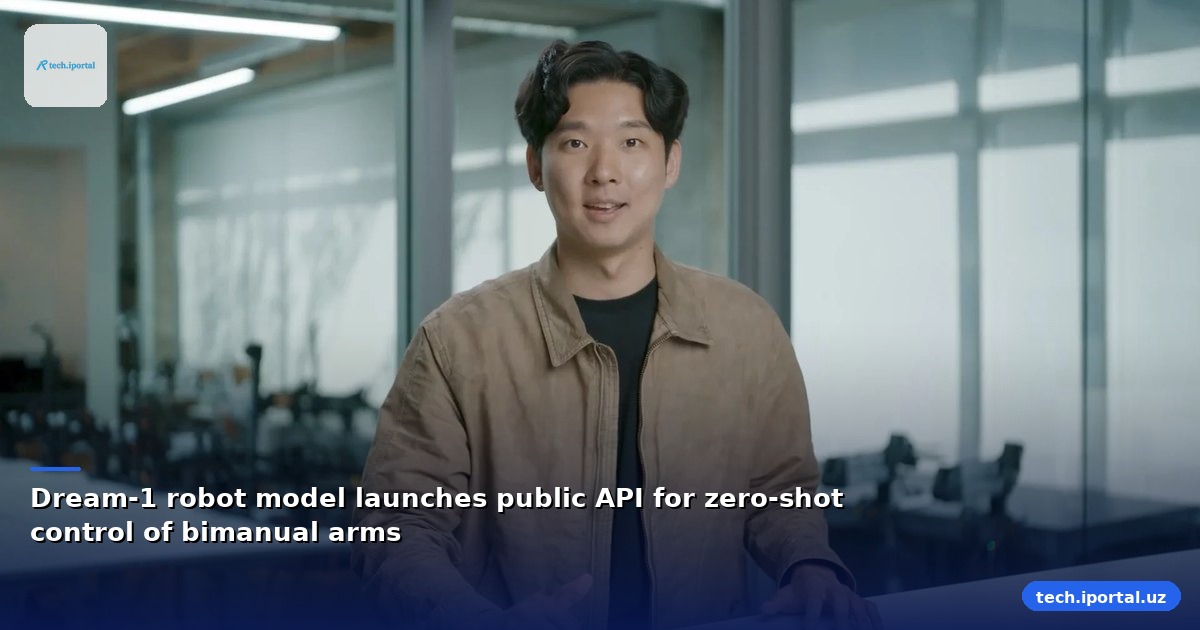
Dream Labs has opened a public API for its new Dream‑1 model, a world‑action model that can control previously unseen bimanual robots with parallel grippers straight out of the box. The service promises zero‑shot task execution without any fine‑tuning, demonstration data, or machine‑learning expertise from the user.
Why Dream‑1 matters for robot adoption
For years the robotics field has faced a classic chicken‑and‑egg dilemma: a robot must be useful to attract buyers, yet usefulness depends on large amounts of robot‑specific data that only appear after many units are deployed. Dream‑1 attempts to break this loop by separating the data‑generation phase from the hardware deployment phase. By offering a generalizable model through an API, the company enables a robot to become functional immediately, while the data collected from its operation feed future model improvements.
import dream

client = dream.DreamClient(
    api_key=<API_KEY>,
)
client.policy({"checkpoint": "dreamlabs/dream-1"})
client.set_observation(observation)
action = client.get_action()
client.close()
Hardware trends that enable the new approach
Two market forces have converged to make Dream‑1 feasible. First, the cost of capable bimanual arms has dropped dramatically; a complete two‑arm setup with parallel grippers can now be purchased for around $2,000. Second, recent research on world‑action models (WAM) shows that a single model can generalize across different embodiments, eliminating the need for robot‑specific training datasets.
These trends create a positive feedback cycle: cheaper hardware puts more robots in users' hands, the general model makes those robots useful from day one, and the resulting operational data improve the model for the next wave of devices.
Technical foundation: World Action Models
Dream‑1 builds on the World Action Model paradigm introduced in the DreamZero paper (Feb 2026). WAMs treat robot actions as transformations in a shared latent space that describes the world, rather than as robot‑specific joint trajectories. This abstraction allows a model trained on data from one robot to infer appropriate actions for a completely different robot, provided the robot can solve inverse kinematics (IK) for the desired end‑effector pose.
In practice, the API receives a description of the current observation (camera images, proprioceptive state, etc.) and returns a high‑level action command. The user’s robot controller then translates this command into joint positions using its own IK solver. Dream‑1’s zero‑shot performance depends on the quality of that solver, and the team provides a detailed guide to help developers achieve optimal results.
Zero‑shot performance across diverse platforms
Dream‑1 has been tested on a range of platforms, from modern $2k bimanual arms to the classic PR2 robot released 18 years ago. In simulation, the model achieved success rates above 80 % on pick‑and‑place tasks, while real‑world trials reported slightly lower but still impressive numbers (70‑75 %). Performance variations are primarily linked to differences in sensor fidelity, latency, and IK solver robustness.
- Modern low‑cost arms: high‑resolution depth cameras and fast IK solvers yielded the best results.
- Legacy research robots: older hardware and noisier joint encoders reduced success rates, but the model still managed to complete basic manipulation tasks.
- Simulation vs. reality: the gap narrows as developers adopt the provided calibration and sensor‑alignment procedures.
One‑shot embodiment learning as a bridge
While zero‑shot control works well for many tasks, the authors acknowledge scenarios where a brief adaptation phase—one‑shot embodiment learning—can close the remaining performance gap. By providing a short demonstration (often less than a minute) on the target robot, Dream‑1 refines its latent representation to better match the robot’s dynamics, boosting success rates by up to 15 % on challenging tasks.
Comparison with existing robot‑learning solutions
Traditional robot‑learning pipelines rely on large, robot‑specific datasets and extensive offline training. Commercial offerings such as NVIDIA Isaac or OpenAI’s robotics API require users to collect data, label it, and often possess deep ML expertise. Dream‑1’s plug‑and‑play approach eliminates these steps, positioning it as a lower‑barrier alternative for small teams, hobbyists, and educational institutions.
@misc{dreamlabs2026dream1,
  title  = {Zero-Shot to New Robots: Introducing Dream-1},
  author = {Dream Labs},
  year   = {2026},
  url    = {https://dreamlabs.ai/research/dream-1}
}
Another distinction is the business model. Dream Labs announced a $90 million seed round and plans to monetize the API via usage‑based pricing, similar to cloud AI services. This contrasts with hardware‑centric vendors that bundle software licenses with expensive robot platforms.
Limitations and open research questions
Despite its promise, Dream‑1 is not a universal solution. Current limitations include:
- Reliance on a functional IK solver; robots without reliable inverse kinematics cannot benefit fully.
- Sensitivity to sensor noise; low‑quality cameras degrade perception and thus action quality.
- Task scope; the model excels at manipulation tasks but has limited capabilities for locomotion or high‑speed dynamic actions.
- Safety guarantees; the API does not enforce collision avoidance, leaving that responsibility to the robot’s low‑level controller.
Future research directions highlighted by the team involve extending the latent action space to incorporate force control, improving robustness to perception errors, and integrating safety layers directly into the model.
Impact on the robotics ecosystem
If the adoption curve follows the authors’ expectations, Dream‑1 could accelerate the democratization of advanced robotics. By lowering the entry barrier, more developers can experiment with autonomous manipulation, leading to a richer ecosystem of applications—from home assistance to small‑scale manufacturing.
Moreover, the data generated by thousands of globally distributed robots could create a virtuous data loop, similar to how early autonomous‑vehicle fleets accelerated self‑driving research. This collective dataset would enable the next generation of world‑action models to handle even more complex tasks and environments.
Getting started with Dream‑1
Dream Labs provides a concise Python client library. After obtaining an API key, users instantiate a DreamClient, send the current observation, and receive an action command. The full tutorial and code snippets are available on the official research page Dream‑1 research page. The company also runs weekly internal hackathons to keep deployment latency minimal.
In summary, Dream‑1 represents a significant step toward general‑purpose robot intelligence by decoupling data collection from hardware deployment. Its public API invites a broad community to experiment, potentially turning the long‑standing chicken‑and‑egg problem in robotics into a self‑sustaining growth cycle.
Asl manba: dreamlabs.ai